Short Film or Feature: How Format Shapes the Viewing Experience
Choose a short film or feature by the kind of story and attention you want, so the format fits your mood, company, and viewing plans.
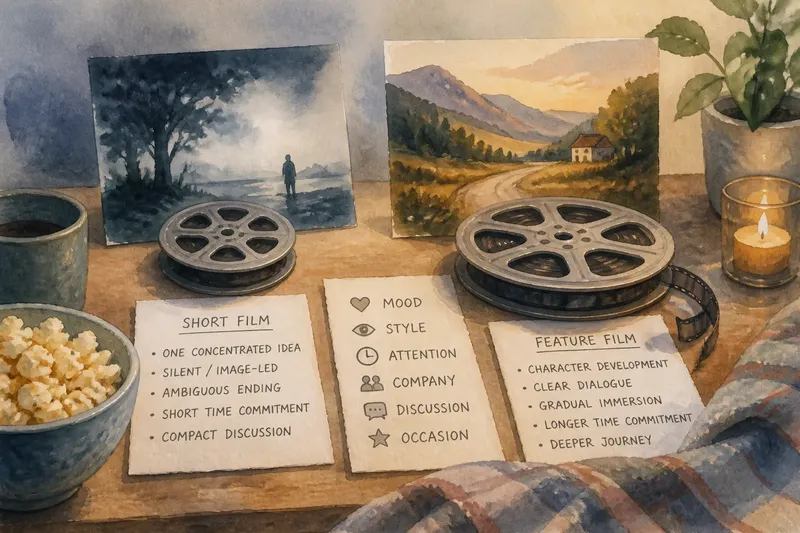
The common mistake in choosing a short film or feature is assuming that length tells you what the viewing experience will feel like. A short can be formally dense, while a feature can unfold in a calm, spacious way. Choosing by runtime alone can leave you with the wrong kind of story for your mood or company.
What changes when a story is short or feature-length?
Format shapes how a film organizes its ideas. A short often centers on a single situation, image, or turn. A feature can develop several relationships, shift settings, or let a character change gradually. These are tendencies, not rules: a short can suggest a whole world, and a feature can keep its focus tight.
Think of a short as a concentrated form, not a smaller feature. It may rely on visual clues, silence, or an ending that leaves questions open. A feature has more room to establish context and let themes recur, but its extra space may also bring detours or a slower pace.
Choose the form that suits the experience you want. For a single striking idea, a short may feel complete. For a longer stay with a character or setting, a feature may give the story room to develop.
Which format suits your mood and attention?
Your attention depends on the film’s style as much as its length. A rapid montage or a quiet, symbolic short can ask for close focus. A familiar genre feature may be easier to follow casually, while a layered drama can require sustained attention.
Match format to your present mood, then check the tone and style of the specific title. If you want something contained and immediate, consider a short. If you want gradual immersion, consider a feature. When you are tired or distracted, look for clues in a synopsis or trailer about pacing, dialogue, and visual density rather than treating runtime as a shortcut.
How does the viewing company affect the choice?
Different formats can serve different kinds of shared viewing. A short may give a group one clear subject to discuss without asking everyone to commit to a longer story. A feature can work well when the group wants to settle into a shared world and follow its turns together.
Consider whether everyone wants the same level of focus. A visually intricate short may be a poor fit for a room where people expect to talk. A relaxed feature may leave more room for conversation, but frequent discussion can still make plot-heavy scenes difficult to follow. Agree on whether the film is the focus or a backdrop before choosing.
How do you choose a short film or feature?
- Check the mood you want. If you want one concentrated idea, choose a short; if you want gradual immersion, consider a feature.
- Check the film’s style. If the synopsis suggests dense imagery or ambiguity and you want an easy watch, choose a clearer, more direct title instead.
- Check your attention. If you expect to be distracted, choose a film whose pace and story are easy to rejoin; otherwise, choose the more demanding form that interests you.
- Check the group’s preference. If viewers want to talk through the film, choose something that can withstand discussion; if they want focused viewing, agree to keep conversation for afterward.
- Check the kind of ending you want. If you want a resolved story, look for that quality in the description; if you enjoy ambiguity, choose a title that leaves interpretive room.
- Check the intended occasion. If the film should be one distinct part of the gathering, choose a title that feels complete on its own; if the group wants to spend time in one story world, consider a feature.
What should you ask before choosing a short or feature?
Does a short film always tell a simpler story?
No. A short may compress its story or leave meaning unstated, which can make it demanding to interpret. Its limited duration describes its form, not how easy it is to follow.
Is a feature always more immersive?
Not necessarily. A feature has more room to develop a setting or character, but immersion also depends on pacing, performance, and your interest in the subject.
How can you tell whether a short is right for a group?
Check its subject and style, then consider how the group wants to watch. A focused, visually intricate short may suit a quiet audience, while a more direct story may be easier to discuss afterward.
What if the group cannot agree on a format?
Decide what matters most for that gathering: a shared story, a brief conversation starter, or room for other activities. Then choose the format that best serves that purpose, rather than treating length as a compromise by itself.
How can you compare two specific titles?
Say you are choosing for an invented movie night with a friend who enjoys discussing symbolism, while you want a story that feels complete and not overly demanding. You have two fictional options: Glass Orchard, a short described as silent and image-led, and Northbound Letters, a feature described as a character-centered drama with clear dialogue. First, you identify the shared interest in interpretation. Next, you notice that the short’s silent, image-led style may suit that interest but could require close attention; the feature’s dialogue may make its story easier to follow, though it asks for a longer stay with the characters. You choose Glass Orchard if the group wants a compact discussion of visual clues, or Northbound Letters if the priority is following a character’s development. The choice turns on the desired experience, not on which title is shorter.
For a short film or feature, the most useful comparison is between the story’s shape and the experience you want to share. Check style, mood, and the group’s appetite for focused or gradual storytelling. That gives you a better reason to press play than runtime alone.